There are two increasingly useful postures for dealing with modern enterprise technology.
The first is a certain kind of Gen X feralness: a deeply ingrained suspicion of anyone who tells you the future has arrived and you need to get on board immediately.
The second is anger. Not screaming-at-the-clouds anger. Not Twitter outrage. Not performative rage dressed up for better engagement metrics. I mean the quieter kind: the anger that builds after years of watching supposedly serious people make the same bad decision again, only this time with a bigger budget and a Gartner slide.
Both are proving extremely useful as corporations race toward agentic AI. Because apparently, we have learned absolutely nothing. Again.
Every executive presentation about AI now seems to contain some variation of the same mandate:
- We need to move faster.
- We need agents.
- We need autonomous workflows.
- We need AI embedded everywhere.
- Our competitors are doing it.
- Why aren’t we doing it?
- Can we have it by Q4?
There is usually a chart. The chart goes up and to the right. Everyone nods.
And somewhere in the back of the room, an engineer quietly wonders whether anyone has considered what happens when the thing making autonomous decisions is wrong. Nobody likes that person. That person is “being negative.” That person “doesn’t understand the opportunity.” That person is “focused on edge cases.” That person has also seen production.
We Have Seen This Movie
The problem isn’t agentic AI. Agentic AI is fascinating.
Give a model access to tools, memory, APIs, systems, and some ability to decide what to do next, and suddenly you have something considerably more interesting than a chatbot that writes mediocre emails. You also have something considerably more dangerous.
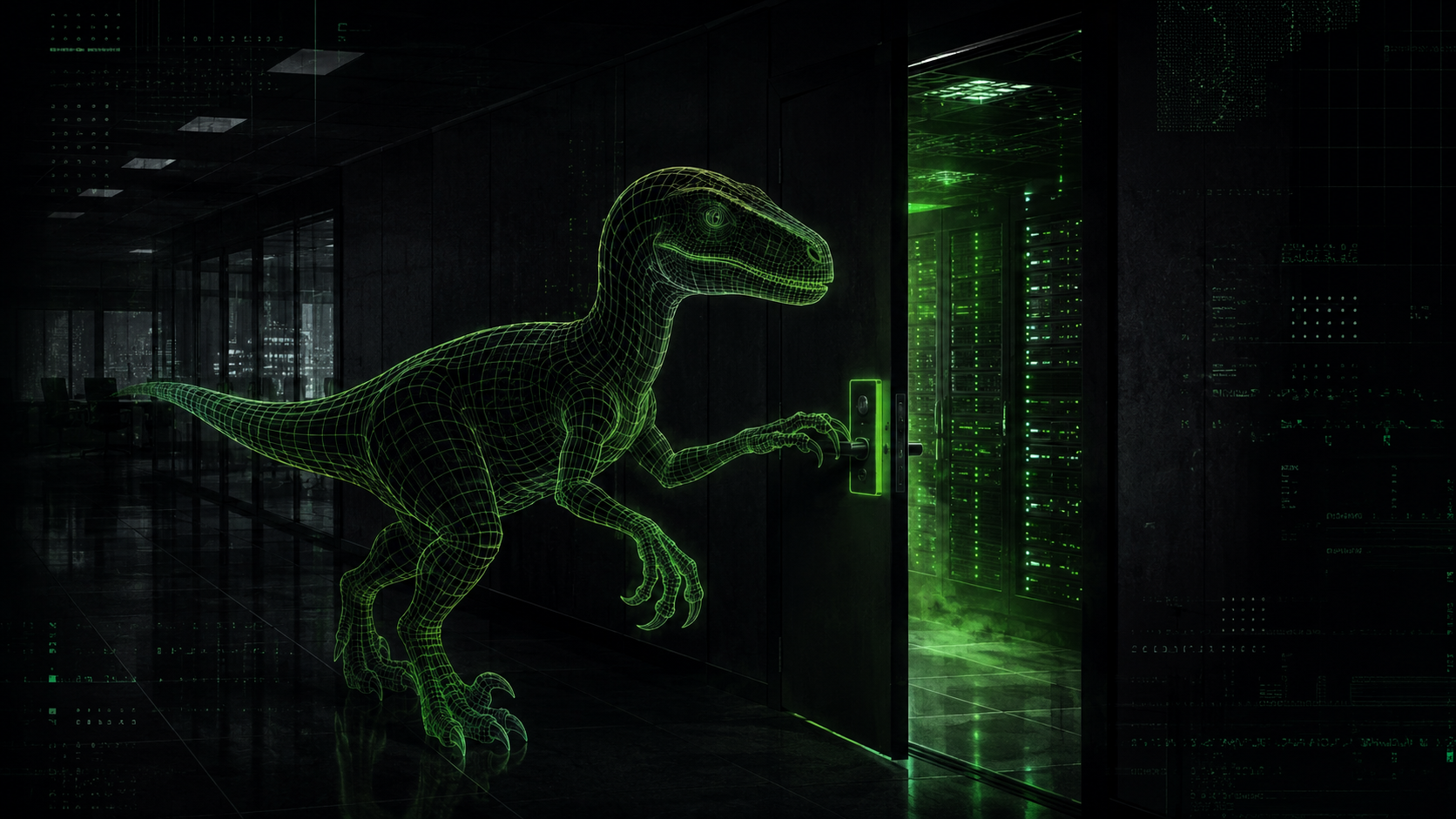
Not Skynet dangerous. At least not yet. More like velociraptor-opening-the-kitchen-door dangerous.
The raptor itself isn’t the surprising part. We already knew there were raptors. We built the raptors. We funded an entire goddamn raptor program. The important moment is when someone realizes: Oh. It figured out the handle.
That’s the part corporate AI strategy seems determined to speed-run. We are giving increasingly capable systems access to increasingly consequential tools while congratulating ourselves on how much friction we’ve removed. Friction, incidentally, is sometimes the thing preventing the velociraptor from getting into the control room.
But Think of Productivity
There is an almost religious belief in corporate technology that if something can be automated, it should be automated. I have never understood this. There are processes that should absolutely be automated. There are also processes that should be taken behind the building and shot.
Automating a bad process does not make it a good process. Giving an AI agent control of a bad process does not make it intelligent. It just means the bad process can now operate twenty-four hours a day without becoming tired, bored, embarrassed, or concerned that perhaps what it is doing is completely fucking insane.
This is where the anger comes in.
Because we know this. We’ve known about it for decades. Every generation of enterprise technology arrives promising to eliminate complexity, and somehow, we end up with twelve dashboards, seventeen SaaS subscriptions, six overlapping identity systems, and a quarterly meeting devoted to figuring out who owns the integration nobody remembers buying. Then someone walks into the room and says:
AI will simplify everything.
Sure. Of course it will. What could possibly go wrong?
Mom Has Discovered Facebook
There is another technological milestone I use to recognize when something has crossed into dangerous territory. It’s when Mom learns how to use it. Not my mother specifically. Mothers generally.
There was a point when Facebook was a weird little thing for college kids. Then everybody joined. Then your parents joined. Then your mother discovered that she could comment on photographs. Then she discovered the Share button. Then one morning you opened Facebook and learned that your aunt thinks Bill Gates is giving away $5,000 to everyone who reposts a picture of a Winnebago.
Technology hadn’t suddenly become evil.
It had become accessible. That matters. Powerful technology behaves very differently when the barrier to using it collapses. We are rapidly doing the same thing with automation. For years, making a system autonomously manipulate production infrastructure required someone who understood scripting, APIs, authentication, permissions, error handling, and at least enough basic self-preservation to know that DELETE is an exciting HTTP verb. Now we’re working toward:
Tell the agent what you want.
That’s incredible. It is also the moment Mom discovers Facebook. Suddenly the limiting factor isn’t technical skill. It’s judgment. And if you’ve spent any significant amount of time inside a corporation, you know exactly how comfortable that should make you feel.
This is where someone inevitably says:
Don’t worry. There will always be a human in the loop.
Fantastic. Which human? The one responsible for approving 600 agent actions before lunch? The engineer managing nine systems because the headcount reduction was justified by the automation? The manager who clicks Approve because the system has been correct the previous 437 times? The person who doesn’t understand what the agent is doing but was told during implementation that the AI is “95 percent accurate”?
Human oversight becomes less meaningful as automation becomes more reliable.
That’s the paradox. When a system fails constantly, people watch it. When it works almost all the time, people stop watching. That’s when the interesting failures happen. Not because humans are stupid. Because humans are humans. We habituate. We trust. We get busy. We assume someone else checked. And corporations are exceptionally good at turning “human in the loop” into “human technically adjacent to the loop for audit purposes.”
Faster
The thing that worries me isn’t that companies are adopting AI.
They should. We should. I want the tools; I want the automation. I want agents that can diagnose problems, correlate signals across systems, retrieve knowledge, perform routine remediation, and eliminate entire categories of pointless human toil.
I would happily spend the rest of my career never asking someone whether they’ve rebooted their laptop.
What worries me is the demand for speed without maturity. Every company is terrified that another company will figure this out first. That fear creates pressure.
Pressure creates shortcuts. Shortcuts become architecture. Architecture becomes technical debt. Technical debt eventually becomes an incident report explaining why an AI agent deleted 14,000 customer records because someone accidentally gave it production credentials and described its objective as “clean up stale accounts.”
And after that?
There will be a task force. There will be a framework. There will be a new Vice President of Responsible Autonomous Systems.
There will be mandatory training. Someone will invent a maturity model. Consultants will arrive. The slide deck will have tasteful gradients. And everyone will behave as though the danger was previously unknown.
It wasn’t. The raptor was standing next to the door the entire time.
Consequences Are How We Learn Now
This may be the most Gen X thing I believe: Nobody is going to stop until somebody gets hurt.
Maybe not physically. Hopefully not physically.
But something significant is going to happen. A major outage. A financial loss. A security breach. A cascading automated decision nobody can unwind quickly enough. An agent interacting with another agent interacting with another system until everyone discovers that observability was apparently not included in the proof of concept.
Something.
Because warnings rarely beat incentives.
If an executive gets rewarded for deploying AI faster, the theoretical possibility of a future incident doesn’t compete very well with the very real possibility of a promotion this quarter.
That’s not an AI problem. That’s a human systems problem. And unfortunately, we’re giving the human systems better tools.
So, What Do We Do?
Not stop. That’s important. The answer isn’t crawling under a desk and waiting for the AI winter. It’s refusing to confuse moving quickly with moving recklessly.
Build agents. Give them tools. Let them handle increasingly meaningful work. But understand the blast radius before expanding it.
Start with reversible actions. Make permissions narrow. Log everything. Require meaningful approval for consequential changes. Assume the agent will eventually misunderstand something. Assume the API will return something weird. Assume the documentation is wrong. Assume a human will click the button without reading. And for the love of whatever gods remain willing to supervise us, make sure there is a big red switch somewhere that turns the fucking thing off.
Because the future isn’t going to arrive as a chrome robot announcing that humanity has become obsolete. It’s going to arrive at 2:13 on a Tuesday afternoon when somebody says:
“That’s strange.”
Then:
“Did anyone change anything?”
Then:
“Wait.”
Then:
“Oh, shit.”
And somewhere, quietly, a velociraptor will turn the handle.
We’ve seen this movie.
Maybe this time we could try not walking into the kitchen.