We Were Never Cynical. We Were Paying Attention.
Everybody is obsessed with generational labels. Boomers killed the economy. Millennials killed napkins. Gen Z can’t look up from their phones. And Gen X? Apparently we just wandered off somewhere in 1994 and nobody bothered to file a missing-person report.
Which, honestly, tracks.
We are the middle child of modern history. Too young for Woodstock, too old for TikTok, born into an analog world and handed the keys to the digital one. We grew up while one version of society was disappearing and another had not fully arrived yet, and that did something to us. People call Gen X cynical, detached, sarcastic, overly independent, distrustful of institutions, and bad at asking for help. They’re not entirely wrong. They’re just confusing the symptoms with the disease.
Gen X wasn’t born cynical. We were paying attention.
Nobody Is Coming
Start with the latchkey kid.
For millions of Gen X children, being home alone after school wasn’t considered a parenting crisis. It was Tuesday. You got off the bus, walked home, let yourself into the house, and stayed there until somebody got home from work. There was no babysitter, no text message telling Mom you made it, no FaceTime, no Find My iPhone, no Ring camera quietly reporting that the twelve-year-old had successfully entered the perimeter.
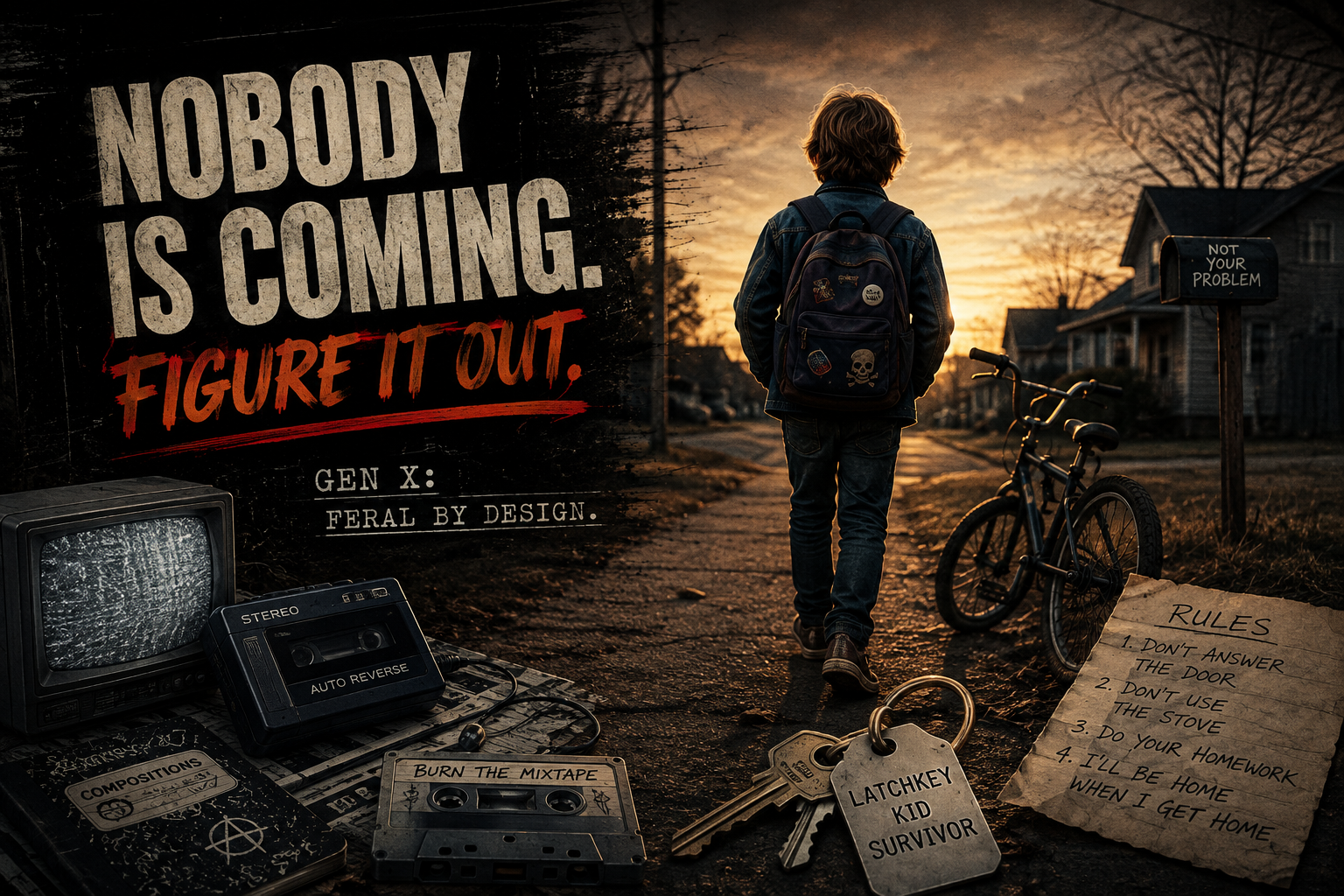
Maybe there was a note on the refrigerator: Don’t answer the door. Don’t use the stove. Do your homework. I’ll be home at six.
Good luck.
By the mid-1980s, millions of American children were regularly spending time alone after school. Whatever the exact number, the cultural reality was obvious: a huge part of a generation learned very early that nobody was hovering nearby waiting to solve the next problem.
That environment teaches you something quickly: nobody is coming. Figure it out.
Not in some dramatic Dickensian sense. It was simply the operating model. Bike chain falls off? Flip the bike over, get grease all over your hands, and figure out how the chain works. Television goes fuzzy? Adjust the antenna. Still fuzzy? Hit it. We called this percussive maintenance, although most of us didn’t know there was a name for it.
You made decisions because there was nobody immediately available to make them for you. You couldn’t text Mom for permission. You couldn’t Google what to do. You couldn’t ask Alexa. You made a choice and lived with whatever happened next. Sometimes the consequence was minor. Sometimes you discovered that putting aluminum foil in a microwave creates weather.
Either way, you learned.
Consequences Were Real
Our childhoods had remarkably little abstraction between action and consequence. You screwed up and something happened. That was generally the lesson. Discipline wasn’t usually a forty-five-minute family summit where everyone explored how the event made them feel. You did something stupid, you got punished, and that was the end of the story.
I’m not arguing this was always good parenting. Some of it absolutely wasn’t. But it created what I’d call a high-contingency environment. Action and outcome were closely connected, and there wasn’t much buffer between the two.
Spend enough time in that kind of environment and you learn to think ahead. Not because you’re naturally pessimistic, but because you’ve already learned that decisions have downstream effects. Gen Xers can seem like we’re constantly running disaster simulations in our heads: What happens if this fails? What happens after that? What’s the backup plan? What if the backup plan fails? What if Bob is an idiot? Have we accounted for Bob being an idiot?
People sometimes call this defensive pessimism. I call it Tuesday.
Hope for the best. Plan for the worst. The worst has an irritating habit of showing up without an appointment.
Then We Watched the Adults
The other thing Gen X learned early was that adults frequently had no idea what they were doing.
Our parents told us about loyalty, commitment, keeping promises, and doing the right thing. Then we watched marriages disintegrate. We watched companies preach loyalty while laying off people who had given them decades. We watched politicians tell us everything was under control while the evening news provided substantial evidence to the contrary.
Watergate was still part of the national hangover. Iran-Contra happened on television. The AIDS crisis demonstrated exactly how badly institutions could fail people when fear, politics, prejudice, and bureaucracy collided. Factories closed. Jobs disappeared. Entire communities discovered that the company everyone assumed would always be there had other plans.
The message wasn’t subtle: systems fail, people let you down, and promises have expiration dates.
So we developed a defense mechanism that can look like detachment from the outside. Don’t get too excited. Don’t trust too quickly. Don’t believe the brochure. Read the fine print. Always know where the exit is.
That’s not necessarily cynicism. Sometimes it’s just pattern recognition.
Everything Is Fine
Our best psychological weapon was irony.
Gen X weaponized ironic detachment before anyone had a name for it. Everything is a joke. Nothing is that serious. And the darker things get, the funnier the joke becomes. Ask me about my Holocaust repertoire.
Try growing up during the Cold War. Adults calmly explained that somewhere on Earth were enough nuclear weapons to erase civilization several times over. Some schools still ran versions of civil-defense drills. Get under the desk. Cover your head. Apparently plywood was expected to perform admirably against global thermonuclear war.
But don’t worry. Everything is fine.
That’s a strange reality for a kid. The adults say everything is under control while everything you can see suggests otherwise. Eventually contradiction itself becomes normal, and you learn to laugh at it. What else are you going to do? That’s where a lot of Gen X gallows humor comes from. We laugh so we don’t scream. We make the inappropriate joke at the funeral. We stare into the abyss until the abyss becomes uncomfortable and looks away.
Humor creates distance. And distance feels safe.
Privacy Used to Exist
Gen X may also be the last generation to have experienced widespread stupidity without permanent documentation. When you did something idiotic at school, maybe ten people knew. Twenty if it was particularly spectacular. Somebody might tell the story at a party five years later and embarrass you again, but eventually it disappeared.
There was no video, no screenshot, no searchable archive, and no algorithm resurfacing your worst twelve seconds six years later because engagement is engagement. We had the enormous luxury of being able to be young and stupid temporarily, and the past could actually become the past.
That shaped our relationship with privacy. Privacy wasn’t a setting. It was the default condition of existence. You didn’t document every meal, announce every opinion, or turn every experience into content. Sometimes something happened and only the people who were there knew about it.
Imagine that.
Maybe that’s why so many Gen Xers instinctively recoil when an application asks for access to our contacts, location, microphone, photographs, browsing history, blood type, favorite breakfast cereal, and firstborn child so we can get fifteen percent off a pair of socks.
We remember when none of that was normal.
Shut Up and Do the Work
All of this produced a peculiar work ethic.
We don’t tend to romanticize it. We don’t post inspirational LinkedIn essays about how getting up at 4:37 a.m. changed our lives. A lot of us just work.
Show up. Do the thing. Go home.
Many Gen X childhood jobs look astonishing through modern eyes. Paper routes before sunrise. Babysitting other people’s children while barely old enough to qualify as a child yourself. Fast-food registers where you had to calculate change because the machine didn’t always do the thinking for you. Stocking shelves, mowing lawns, cleaning things, moving things, selling things. Raw, largely unfiltered introductions to adult responsibility.
At the same time, we watched our parents get chewed up by corporate America. So we learned another contradiction: work matters, but the company doesn’t love you.
That’s an important distinction. Gen X doesn’t necessarily believe in corporate loyalty because we’ve seen that movie and we know how it ends. The company sends a heartfelt email about how difficult the decision was. Security deactivates your badge. Please have your personal belongings removed by 5 p.m.
But we became obsessive about something else: competence.
If the system won’t protect you, make yourself valuable. Know things. Fix things. Become the person people call when everything breaks. Make yourself quietly indispensable. Not because you’re expecting a gold watch, but because competence feels like armor.
The Gen X Paradox
This creates what I think of as the Gen X paradox.
We’re fiercely independent, but also quietly collaborative. We won’t ask for help because we’ve been solving our own problems since we were eight, but if you need help, we’re there. No announcement. No inspirational post. No photograph of ourselves helping. We just show up.
Part of that probably comes from how important friendships became when parents weren’t always around. Friends weren’t networking opportunities. They were infrastructure. They were the person whose house you went to, the person who knew where you were, the person who helped push your broken bike home, the person whose mother might feed you because nobody had seen your mother since breakfast.
Friends became family because, sometimes, they had to. That stuck.
Authority?
Hah. Hahah. Hahahahahahahah. HAHAHAHAHAHAHAH I’M LAUGHING SO HARD I CAN’T EVEN ROFLMAOLMAFO!!one111.
cough
Gen X has a complicated relationship with authority. We don’t necessarily reject it. We just don’t believe the title proves anything. Show us competence. If you know what you’re doing, we’ll follow you through fire. If you’ve earned your position through knowledge, judgment, and experience, there’s no problem.
But if you’re an executive who speaks fluent PowerPoint and somehow manages to use fourteen hundred words without communicating a single identifiable thought, our patience approaches zero.
We’ve watched incompetent authority figures make catastrophic decisions our entire lives. We learned early that being in charge and knowing what you’re doing are two entirely different conditions.
So blind obedience doesn’t come naturally.
Prove it. Explain it. Show your work.
And if the answer is bullshit, don’t expect the org chart to make it smell better.
Economically Speaking, That Was Fun
Then there’s money.
Gen X managed to repeatedly arrive at important economic milestones immediately before someone pulled the fire alarm. Older Gen Xers entered adulthood around the economic turbulence of the early 1980s. Others started careers around the early-1990s downturn. Then came the dot-com collapse, September 11 and its economic aftermath, and finally 2008, which landed while much of Gen X was deep into careers, mortgages, retirement savings, and raising families.
Then, because apparently the universe had unused material, there was a global pandemic. This creates a particular relationship with financial security.
Namely: it isn’t real.
Jobs disappear. Markets crash. Companies merge. Pensions evaporate. Industries transform. Entire career paths can cease to exist while you’re eating lunch. Maybe that’s why so many Gen Xers maintain side gigs, consulting work, second skills, backup plans, or multiple income streams. It isn’t necessarily entrepreneurial enthusiasm.
Sometimes it’s just: diversify or die.
If you’ve watched everything disappear often enough, redundancy starts feeling like common sense.
Unfortunately, There Is Baggage
None of this makes Gen X superheroes. Quite the opposite. Some of the things that made us extremely capable also fucked us up.
Hyper-independence has a cost. A lot of us don’t seek social support when we’re under stress because asking for help feels uncomfortably close to failure. Vulnerability feels dangerous. Admitting you’re overwhelmed can feel like announcing incompetence.
We’ve been trained to handle it ourselves.
So we do. And do. And do. Until sometimes we can’t.
This makes Gen Xers remarkably useful during a crisis. Building on fire? Fine. System down? Let’s go. Everyone else panicking? Move. We’ll figure it out. But ask that same person to tell someone they’re scared, overwhelmed, lonely, or need help? Suddenly we’ve encountered an undocumented API.
The programming runs deep.
Knowledge Used to Have Weight
Before Google, finding something out required effort.
Actual physical effort.
You went to the library. You searched the card catalog. You walked through the shelves. You found the wrong book. You found another book. You discovered the book you actually needed had been checked out by some bastard from seventh period. Information had weight. It occupied space. Obtaining it cost time. And when knowledge costs something to acquire, you tend to hold onto it differently.
We also learned how things worked because there often wasn’t another option. Bike breaks? Take it apart. Stereo stops working? Check the wires. Computer won’t boot? Start removing things until it does. There was an intuitive belief that the physical world was understandable, that with enough patience, enough swearing, and the correct screwdriver, the problem would eventually surrender.
That mindset followed us into the digital world.
There’s always a reason.
Find it.
The Last Bored Generation
We may also be the last generation that remembers being truly bored.
Not “nothing interesting is showing up in my feed” bored.
Actual boredom.
Nothing on television. Nobody home. Friends unavailable. No Internet. No phone containing the combined entertainment output of human civilization. Just you and several hours.
So you wandered. You built something. You broke something. You read. You listened to the same album twelve times. You stared at the ceiling. You thought. You learned how to exist alone with your own brain.
I’m not convinced we’ve fully understood what humanity traded away when boredom disappeared, because boredom is uncomfortable. And discomfort occasionally produces interesting things.
The Bridge Generation
That’s what makes Gen X strange.
We grew up at the seam. The old world was dying and the new one hadn’t arrived yet.
We remember rotary phones and artificial intelligence. Paper maps and GPS. Card catalogs and Google. Three television networks and infinite streaming. Waiting three weeks for a photograph to come back from the developer and watching someone broadcast lunch to 40,000 strangers in real time.
We aren’t purely analog. We aren’t purely digital. We’re the bridge.
And bridges develop a particular understanding of both shores.
Maybe that’s why Gen X often feels slightly out of place everywhere. We’re the middle child of modern history. Nobody throws us a parade.
Fine.
We didn’t ask for one.
We don’t necessarily want recognition. We don’t need everyone to know what we did. We just keep things running, fix what broke, help when somebody needs it, make the inappropriate joke, keep an exit strategy, assume the system will eventually fail, and know where the tools are.
Then, when everything inevitably catches fire, we look around at the people screaming, pick up the extinguisher, and get to work. Because nobody is coming.
We figured that out a long time ago. And maybe that’s the most Gen X thing of all.
Not needing the credit. Not expecting anyone to notice.
Just getting it done and moving on.