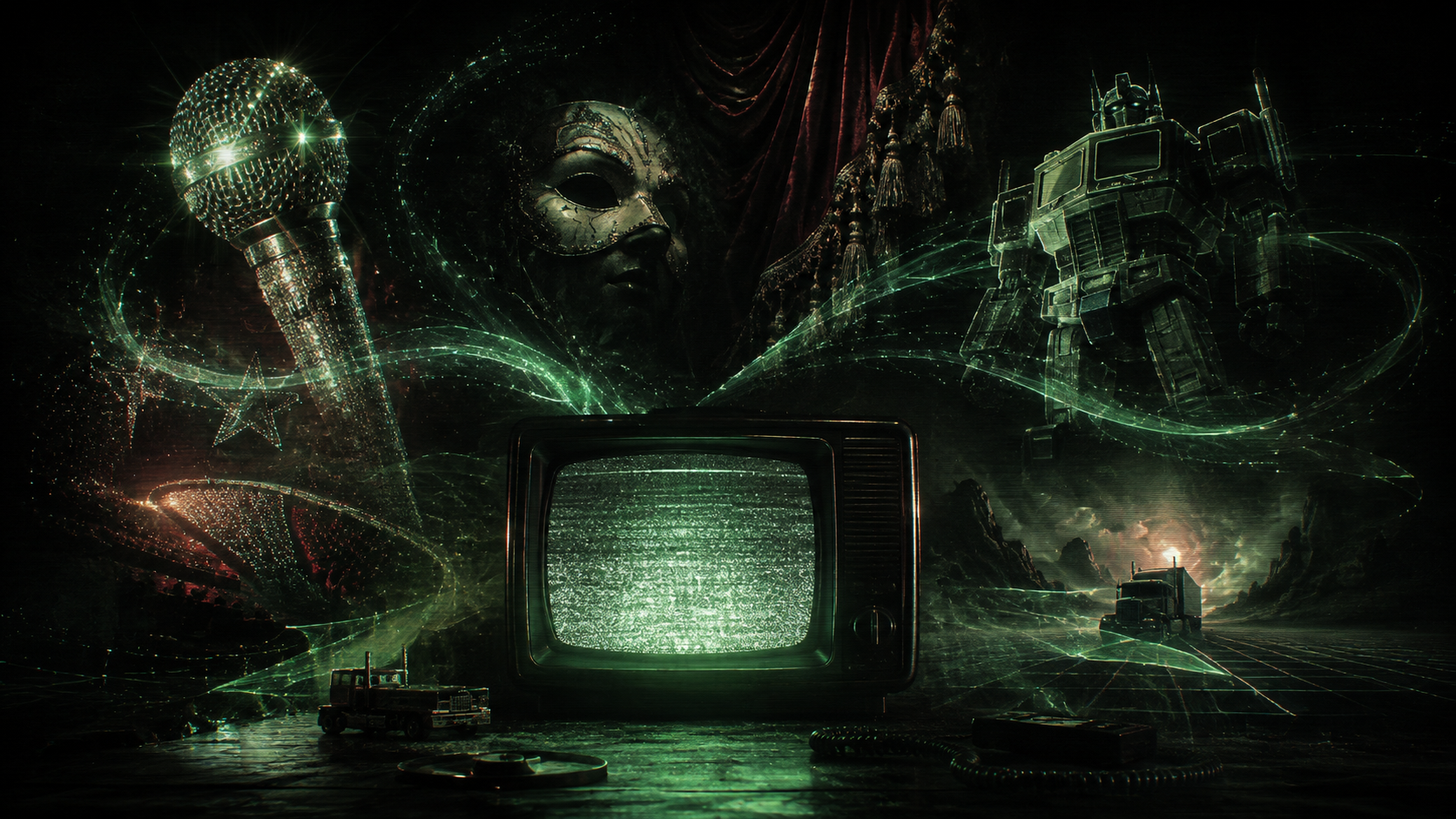
There are weeks when the universe desperately needs an editor. This was one of them.
Dolly Parton. Tim Curry. Peter Cullen.
Three people who occupied completely different corners of popular culture, gone almost at once. And somewhere between seeing the headlines and performing the now-standard ritual of checking whether the Internet was lying to me, I realized this one hit differently. Not because I knew them. Obviously, I didn’t. They didn’t know me either. Peter Cullen never sat me down and gave me advice about courage. Tim Curry never showed up at Thanksgiving wearing something wildly inappropriate and insulting the potatoes. Dolly Parton never slipped me twenty bucks when my parents weren’t looking.
But somehow those descriptions still feel right.
Peter was the voice of my childhood. Tim was the gloriously weird uncle. Dolly was the cool aunt who had apparently figured out the entire scam years before everyone else. Losing them feels less like celebrity news and more like somebody quietly removing furniture from the house you grew up in. You haven’t lived there for years. Maybe you haven’t thought about that chair in decades. But you knew where it was supposed to be.
The Voice
There are voices that bypass conscious thought completely, and Peter Cullen had one of those voices. For an entire generation of kids, he wasn’t simply the guy who voiced Optimus Prime. He was Optimus Prime.
That distinction matters.
Saturday morning cartoons weren’t content libraries. There was no infinite scroll, no algorithm shoveling another eighteen hours of vaguely similar shit into your face because you paused on a robot for three seconds. Things came on at a certain time. You watched them. Then you waited a fucking week.
Which meant they had time to live in your head. And Peter Cullen’s Optimus Prime lived in a lot of ours.
That voice meant calm. Authority without cruelty. Strength without swagger. A giant alien robot truck somehow demonstrated a healthier model of leadership than quite a few actual adults many of us would encounter later. What makes it better — and sadder now — is that the voice wasn’t really invented for Optimus Prime. It came from Peter Cullen’s brother.
Larry Cullen had served as a Marine officer in Vietnam. Peter was living with him when the Transformers audition came along. Cullen used to tell the story of explaining to Larry that he was auditioning to play a truck, which understandably got a laugh.
Then he clarified: a hero truck.
Larry told him that if he was going to be a hero, he should be a real hero. Not the Hollywood version. Not the guy screaming so everyone knows he’s tough. Be compassionate. Have dignity. Be strong enough to be gentle. Peter went to the audition, looked at the character, thought about his brother, and let Larry’s voice come out.
Optimus Prime was born.
I love that story more now than I did when I first heard it. Because as a kid, Optimus Prime was a robot who turned into a truck and beat the shit out of Decepticons, which remains objectively excellent. But somewhere underneath all the lasers and transforming cassette players, there was something else getting transmitted. Peter Cullen was passing along something his brother had taught him: a definition of heroism that wasn’t based on domination, volume, or being the biggest asshole in the room and mistaking everyone’s silence for respect. Strength that doesn’t need to constantly prove it’s strong. Compassion without weakness. Gentleness without surrender.
We didn’t know Larry Cullen. Most of us didn’t know Peter Cullen. But millions of us heard that lesson anyway.
That’s culture at its best. One person gives something to another person. They turn it into a story. Some kid watches it sitting six feet from a CRT television eating cereal composed primarily of sugar and substances probably no longer approved by the FDA.
And forty years later, the lesson is still in there. Waiting.
The Weird Uncle
Then there was Tim Curry.
Jesus Christ, Tim Curry.
Some actors disappear into roles. Tim Curry seemed more interested in grabbing the role by the throat, making direct eye contact with the audience, and asking whether everyone was absolutely certain they wanted to continue.
Of course we did.
Frank-N-Furter. Darkness. Wadsworth. Pennywise. Long John Silver. A résumé that reads less like an acting career and more like the guest list for a party your parents specifically told you not to attend. Curry made weirdness look like a perfectly reasonable career choice, and that’s more important than it sounds. A lot of us grew up in a culture that claimed to value individuality right up until somebody actually became an individual. Then everybody got nervous.
Tim Curry didn’t seem particularly interested in making anybody comfortable.
Rocky Horror alone blew a hole through the tidy little walls people had built around gender, sexuality, theater, camp, conformity, and what the hell an audience was supposed to do while watching a movie. It didn’t politely request admission. It kicked the door open wearing fishnets. For kids who already suspected that “normal” was mostly something adults invented to keep paperwork manageable, people like Curry were evidence. You could be strange. Not quirky in the carefully focus-grouped corporate sense. Actually fucking strange.
You could lean into it. You could turn it into art.
Every family needs that uncle. Every culture does too.
The Cool Aunt
And then Dolly.
Dolly Parton somehow always seemed permanent. Not immortal exactly. Just part of America. Mountains, highways, bad coffee, Dolly Parton.
She had been famous before many of us were born and somehow never became trapped in amber. Singer, songwriter, actor, businesswoman, philanthropist, walking rhinestone supernova. But the remarkable thing about Dolly wasn’t simply that she was talented. Lots of famous people are talented. She figured out something considerably harder: how to be completely, aggressively yourself without requiring everybody else to become you.
That is a rare fucking skill.
Dolly could be glamorous without pretending glamour was seriousness. Funny without making herself small. Shrewd without becoming cynical. She could come from somewhere very specific without insisting everyone else had to come from there too. And while plenty of celebrities spend their later years talking about their “legacy,” Dolly quietly constructed one while everybody else was busy writing mission statements. Her Imagination Library put hundreds of millions of books into the hands of children.
The idea was basically: kids should have books, so give kids books.
Wildly radical stuff here in the twenty-first century.
That was Dolly. The cool aunt who knew considerably more than she let on, laughed at herself before anybody else got the chance, and somehow made kindness look like an act of rebellion.
We Were Raised by Ghosts We Hadn’t Lost Yet
There’s a fashionable tendency to dismiss grief over famous people as “parasocial.” Technically, sure. They didn’t know us. But sometimes that word gets deployed as if that means the emotional connection wasn’t real.
Bullshit.
Humans have always built pieces of themselves from stories, songs, performers, books and voices. We just didn’t have an Internet psychology term for it. These people arrived in our homes. Literally. Their voices came out of giant wooden televisions, cheap cassette players, car radios, VHS tapes, movie screens and speakers with foam covers that eventually disintegrated if you touched them.
And they were there while other things were happening. That’s the important part.
Maybe Dolly was playing while your mother cooked. Maybe Clue became one of those movies you and your friends could recite until everyone else begged you to stop. Maybe Optimus Prime was talking about courage while you sat cross-legged on the living room floor.
The brain attaches things. A song becomes a kitchen. A movie becomes a friend. A voice becomes Saturday morning. And then, decades later, someone dies and suddenly the file opens perfectly intact.
For three seconds you’re not fifty-something. You’re ten.
The room comes back. The television is enormous. The carpet feels exactly the way you remember it. Someone who isn’t here anymore is in the next room. And the future hasn’t happened yet.
That’s the ambush.
You think you’re mourning an actor. Then memory kicks the door open.
This Is Going to Keep Happening
Here’s the uncomfortable part: this is the deal now.
The people who built the cultural world of our childhood are old. The musicians whose albums we bought. The actors on the VHS tapes. The writers on the bookshelves. The weirdos on late-night television. The voices coming from cartoons while we ate Count Chocula and wondered whether nuclear war was going to interrupt Voltron.
They’re going to leave. Increasingly often.
There is no clever Gen X sarcasm capable of getting us around that. Believe me, we’ve tried sarcasm on almost everything else. Sometimes successfully.
This isn’t one of those things.
But the answer isn’t to desperately preserve childhood either. Nostalgia becomes toxic when you convince yourself the past was better simply because you were younger in it. The 1980s weren’t magic. We had AIDS, Chernobyl, Challenger, nuclear anxiety, spectacular quantities of secondhand smoke, and supposedly responsible adults reassuring us everything was fine while very clearly having no fucking idea what they were doing.
Some traditions deserve to die. Some probably deserve to be chased into the woods with sticks.
What matters is deciding what gets carried forward.
Be a Real Hero
That’s why I keep coming back to Peter Cullen’s story about his brother.
Larry gave Peter something. Peter carried it into an audition. Then Peter gave it to us.
Maybe that’s the whole fucking thing.
We spend our lives receiving pieces of other people. Some are family. Some are friends. Some are teachers. Some are strangers who recorded a song fifty years ago. Some are actors in fishnets. Some are women from Tennessee covered in rhinestones. Some are giant red-and-blue robots. They give us things, sometimes without even knowing they’re doing it.
Eventually they leave. And then those things become ours to carry.
Peter Cullen gave us a model of strength that didn’t require cruelty. Tim Curry showed us that being strange isn’t something that requires an apology. Dolly Parton demonstrated that kindness, intelligence, ambition and a frankly unreasonable number of rhinestones can coexist perfectly well.
So carry that.
Show somebody younger Clue. Play Dolly in the car. Put on the original Transformers cartoon and explain why the gigantic talking semi truck is making you unexpectedly emotional.
Tell them where that voice came from.
Tell them that behind Optimus Prime was Peter Cullen, and behind Peter Cullen’s Optimus Prime was his brother Larry. A man most of us never knew whose idea of heroism somehow traveled through his younger brother, into a recording booth in 1984, through a cartoon about transforming robots, and into the moral vocabulary of millions of children. That’s astonishing when you think about it.
And maybe that’s how people actually survive. Not literally. We’re still stuck with biology and its aggressively shitty terms of service. But pieces move forward. Voice to voice. Person to person. Generation to generation.
A phrase. A song. A laugh. A ridiculous movie you’ve watched thirty-seven times. An idea about kindness. A giant robot telling you what kind of person you might want to become. The people who helped raise us are starting to disappear. Eventually we will too.
That’s not nihilism. That’s the assignment.
We get our turn carrying the signal, and somewhere along the way somebody younger is watching us, listening to us, learning from us when we don’t even realize we’re teaching them.
So maybe Larry Cullen had it right.
If you’re going to be a hero, be a real hero. Be strong enough to be gentle. And when somebody gives you something worth keeping, pass it on.
The voice eventually goes quiet. The signal doesn’t have to.
Till all are one.